

Young female teacher standing near a chalkboard in a classroom holding books and an envelope with documents, warm daylight
Student Loan Forgiveness for Teachers Guide

Here's something most new teachers discover too late: that $60,000 education degree doesn't pair well with a $45,000 starting salary. You'll spend years—sometimes decades—chipping away at student loans while buying classroom supplies out of pocket.
But there's real help available. The federal government runs programs designed specifically for educators who work in under-resourced schools. These aren't gimmicks or scams. We're talking about legitimate debt cancellation—sometimes the entire balance.
The catch? You need to know exactly what you're doing. Miss one requirement, fill out the wrong form, or teach at a school that's just outside the eligibility criteria, and you'll waste years of qualifying work.
What Is Teacher Student Loan Forgiveness
Federal loan forgiveness for teachers comes in two main flavors, each with different rules and benefits.
First up is the Teacher Loan Forgiveness Program—let's call it TLF to save some typing. This one's been around since the Higher Education Act updates in 1998. Work full-time at a low-income school for five straight years, and you can wipe out up to $17,500 of your federal loans. That's the maximum if you teach high-demand subjects like math or special education. Everyone else caps out at $5,000, which is still better than nothing.
The second option is Public Service Loan Forgiveness, commonly shortened to PSLF. This program takes a different angle: make 120 qualifying monthly payments (that's ten years) while working for a government agency or qualifying nonprofit—which includes most public schools—and whatever balance remains gets erased completely. No cap. If you still owe $80,000 after ten years of payments, it all disappears.
Why do these programs exist? Teacher shortages hit hardest in low-income areas and subjects like science, math, and special ed. Congress figured debt relief might convince more qualified people to teach where they're desperately needed instead of taking higher-paying private sector jobs.
Now, who counts as a teacher here? You need to be state-certified and working in an elementary or secondary school classroom. That includes special education teachers and certain specialists who do direct instruction. Unfortunately, teaching assistants don't qualify. Neither do substitutes, even if you sub full-time. Administrators only qualify if they're also teaching classes—just running a school doesn't count.

Author: Evan Thornton;
Source: sonicmusic.net
Eligibility Requirements for Teacher Loan Forgiveness
Getting forgiveness isn't automatic just because you teach. The requirements are specific, and missing even one detail can disqualify you completely.
Qualifying Schools and Teaching Positions
Your school needs to appear in something called the Teacher Cancellation Low Income Directory. The Department of Education updates this list every year based on student demographics.
Elementary schools make the list when 30% or more of their students come from low-income families. Secondary schools qualify when at least 30% of students receive free or reduced-price lunch. Sounds straightforward until you realize schools hover near these thresholds and can drop off the list from one year to the next.
Here's the good news: if your school qualifies when you start teaching there, you're protected even if it later falls off the directory during your five-year stretch. Documentation matters here—keep copies of each year's directory showing your school was listed.
Full-time employment is non-negotiable. Most districts define full-time as 32 or more hours weekly. Part-time positions don't count toward your five years, though there's a workaround: combine two part-time positions at different qualifying schools to hit full-time hours. The paperwork gets messier, but it works if both schools qualify and you can prove the combined hours meet full-time standards.
Subject area determines your forgiveness amount. Math, science, special education, bilingual education, and ESL teachers can get up to $17,500 erased. Teachers in other subjects max out at $5,000. That's a $12,500 difference—triple the benefit—just based on what you teach.
Each state also maintains its own list of high-need subject areas beyond the federal categories. These change based on local teacher shortages. A foreign language teacher might qualify for the higher amount in one state but not another. Check your state education agency's current designations before assuming you're in a high-need field.
Loan Types That Qualify
Not every federal loan qualifies, and private loans definitely don't make the cut.
For TLF, you can receive forgiveness on Direct Subsidized Loans, Direct Unsubsidized Loans, and the older Subsidized and Unsubsidized Federal Stafford Loans from the FFEL program. The outstanding interest on these loans also gets forgiven along with the principal.
What doesn't qualify: Direct PLUS Loans your parents took out for your education, any Direct Consolidation Loan that paid off parent PLUS loans, and Federal Perkins Loans. If you've got private loans from banks or credit unions, they're completely outside the federal forgiveness system—you're on your own with those.
Here's where timing gets tricky. If you have older FFEL loans, you might need to consolidate them into a Direct Consolidation Loan to access PSLF later. But consolidating at the wrong time can erase your progress. Consolidate after you've already started your five qualifying years for TLF, and you might lose credit for that time. The safest move? Consolidate before beginning your qualifying teaching service, or wait until after you've received TLF forgiveness.
Employment verification creates headaches if you procrastinate. Your school principal or superintendent must certify your teaching service on official forms. Don't wait until year five to start this—administrators retire, schools close, and tracking someone down five years later becomes a nightmare. One teacher in Ohio spent eight months hunting for her former principal who'd retired to Florida just to get a signature. Keep records as you go.
Author: Evan Thornton;
Source: sonicmusic.net
How to Apply for Student Loan Forgiveness as a Teacher
The application process isn't complicated, but it is precise. Sloppy paperwork gets rejected automatically.
Step 1: Verify you've hit the five-year mark. Count complete academic years only. If you started teaching in January halfway through a school year, that year doesn't count. Summer breaks don't interrupt your consecutive years—you just need to teach the full academic years before and after the summer.
Pull employment contracts and pay stubs proving full-time status for each year. Cross-reference your school against the Teacher Cancellation Low Income Directory for each academic year you're claiming. If your school wasn't listed during one of those years, you've got a problem.
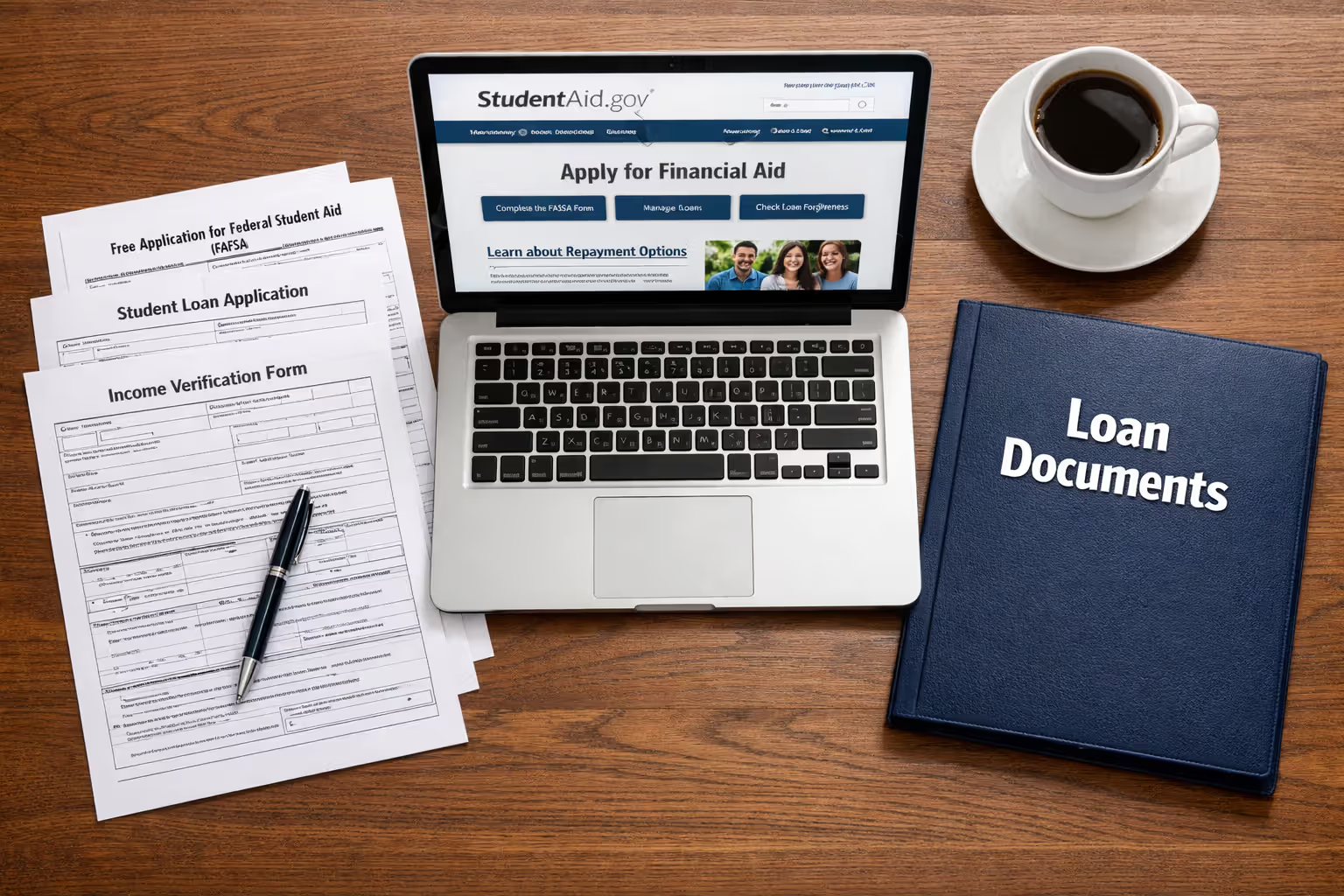
Step 2: Get the right application form. Download the current Teacher Loan Forgiveness Application directly from StudentAid.gov. Don't use an outdated version you found somewhere else. The form asks for detailed information about every year of qualifying service, including dates, grade levels, and subjects taught.
Fill out every field. Incomplete applications get bounced back, costing you months of processing time.
Step 3: Secure employer certification. This is where things get messy. Section 3 of the application requires an authorized school official—usually your principal or the superintendent—to certify everything you've claimed about your employment.
They need to confirm your employment dates, verify you worked full-time, state what subjects you taught, and confirm the school qualified as low-income during your service. Original signatures are mandatory. Most servicers won't accept electronic signatures, so don't try to speed things up by emailing the form around.
If you taught at multiple qualifying schools during your five years, you need certification from each one. One teacher, three different principals to track down.
Step 4: Mail everything to your loan servicer. Figure out which company currently services your loans by logging into StudentAid.gov—don't assume it's the same servicer you started with, because the Department of Education transfers loan portfolios between companies regularly.
Send the application via certified mail with tracking. Keep photocopies of everything. If you have loans with multiple servicers, you'll need to submit separate applications to each one.
Step 5: Keep making payments while you wait. Processing typically takes two to three months, sometimes longer if they're swamped with applications in late summer. Continue your regular payments during this time—you won't get refunds later, and you definitely don't want to go delinquent while your application sits in review.
Step 6: Read your determination letter carefully. Approval means your servicer applies the forgiveness to your eligible loans, hitting unsubsidized loans first. Your monthly bill drops or disappears depending on whether forgiveness covered your entire balance.
Denial letters explain why you didn't qualify and whether you can appeal. Common rejection reasons: school didn't actually qualify one of the years, employment wasn't full-time based on contracts, or loan types don't qualify. Some denials are final; others can be fixed with additional documentation.
Teacher Loan Forgiveness vs Public Service Loan Forgiveness
Most public school teachers qualify for both programs. Choosing between them—or using both strategically—depends on your debt level and career plans.
| Feature | Teacher Loan Forgiveness | Public Service Loan Forgiveness |
| How much gets forgiven | $17,500 tops (high-need subjects) or $5,000 (everything else) | Whatever balance remains—no limit |
| Years of service required | 5 consecutive years at low-income schools | 10 years (120 monthly payments) at any qualifying employer |
| Which loans qualify | Direct Subsidized/Unsubsidized, FFEL Stafford Loans | Direct Loans exclusively (FFEL loans must be consolidated first) |
| Where you can work | Only schools on the Low Income Directory | Any government agency or 501(c)(3) nonprofit, including most public schools |
| Can you use both | Yes—finish this first, then start counting toward PSLF | Yes—but your TLF years don't count toward the 120 payments |
| Payment plan restrictions | None—make standard payments | Income-driven repayment plans work best financially |
| Tax consequences | Forgiven amount isn't taxable income | Forgiven amount isn't taxable income (through at least 2025) |
Let's run some numbers. Say you've got $65,000 in federal loans and teach high school chemistry at a Title I school. TLF could erase $17,500 after five years, dropping your balance to $47,500. Continue teaching at any public school for five more years (that's 60 more payments, bringing you to 120 total qualifying payments for PSLF), and the remaining balance disappears entirely.
Compare that to someone who borrowed $18,000 for their bachelor's degree. TLF might knock out most or all of that debt after five years. Sticking around another five years for PSLF doesn't make sense if there's nothing left to forgive.
The big difference comes down to this: you can't double-count years of service. Your five years for TLF are completely separate from PSLF's 120-payment requirement. Finish TLF first, then your PSLF counter starts from zero. You're looking at 15 total years if you want both.
Educators who sequence Teacher Loan Forgiveness followed by Public Service Loan Forgiveness can eliminate 70% to 100% of their original student debt, depending on loan balance and subject area certification. This sequential strategy provides the highest total debt relief available to teaching professionals
— National Education Association
Common Mistakes That Delay or Disqualify Applications
Even teachers who qualify perfectly still manage to derail their applications through preventable errors.
Missing signatures or incomplete certification sections. This tops the list of application killers. An administrator who forgets to date their signature, leaves boxes unchecked, or signs in the wrong spot creates an invalid application. Before you mail anything, photocopy the completed form and verify every single required field has been filled in properly.
Guessing about school eligibility without verification. Your school serves mostly low-income students, it's in a rough neighborhood, and you're certain it qualifies. But certain doesn't count—only the official Low Income Directory matters. Schools near the 30% qualification threshold bounce on and off the list. A teacher in Nevada worked at a school that qualified for four years but dropped off during her fifth year. She had to teach another full year at a different qualifying school to meet the consecutive requirement.
Consolidating loans without understanding the consequences. Consolidation resets your PSLF payment counter to zero. It can also mess up TLF eligibility if you consolidate after beginning your five qualifying years. One teacher consolidated his loans during his fourth year of teaching, thinking it would simplify things. It invalidated his previous three years, and he had to start his five-year count over.
Losing track of documentation. Principals retire. Schools close. Districts reorganize. Five years is a long time. Keep physical and digital copies of every employment contract, pay stub, and signed form. When Mark's school closed after budget cuts, tracking down his former principal (who'd moved to another state) took seven months. Contemporary documentation saves you from these headaches.
Misinterpreting "consecutive years." Consecutive means uninterrupted academic years. Take a year off to have a baby, even with approved leave? That breaks the chain—you start over from year one when you return. Switch to a non-qualifying school for a year? Start over. Drop to part-time? Start over. The five-year clock is unforgiving.

Author: Evan Thornton;
Source: sonicmusic.net
Skipping annual PSLF certification. TLF only requires certification when you're done, but PSLF works differently—you should submit Employment Certification Forms annually to track your 120 qualifying payments. Teachers who skip this annual housekeeping often discover years later that certain payments didn't qualify due to employment verification problems. Catching issues early beats discovering problems after ten years of payments.
Missing loan servicer transfers. The Department of Education moves loan portfolios between servicing companies without asking borrowers first. Your loans might get transferred from FedLoan to MOHELA to Aidvantage over several years. If you're unaware and send your forgiveness application to your old servicer, it goes nowhere. Always verify your current servicer at StudentAid.gov before mailing important documents.
Tax Implications and What Happens After Approval
Forgiveness comes with financial consequences worth understanding before you celebrate.
Through at least 2025, both TLF and PSLF forgiveness amounts aren't considered taxable income federally. When the Consolidated Appropriations Act passed, it made PSLF forgiveness tax-free, and TLF has always avoided federal taxation. Get $17,500 forgiven? The IRS treats it as if that debt never existed—you won't owe federal income tax on that amount.
State taxes are messier. Most states follow federal treatment and don't tax forgiven amounts, but several states have their own rules. North Carolina, Mississippi, and Indiana have historically treated some forms of forgiven debt as taxable income, though rules change. Check your specific state's current tax code or talk to a tax professional before assuming you're in the clear.
Once your servicer approves forgiveness, they apply it to your eligible loans following a specific hierarchy: unsubsidized loans get paid off first since they accumulate more interest, then subsidized loans. You'll see an updated account statement showing your new balance (or zero balance if forgiveness covered everything). Monthly payment obligations adjust accordingly.
Your credit report gets updated to show forgiven loans as "paid in full" or similar positive language. This doesn't hurt your credit score—actually, reducing your debt-to-income ratio can improve your financial profile when you apply for mortgages or car loans later.
One practical timing issue: payments you make during the 60-to-90-day processing window still apply to your loan balance. You won't receive refunds for those payments. Some teachers strategically switch to income-driven repayment plans with lower monthly payments during this period to minimize what they pay while waiting for approval. Just be careful with timing—you don't want to miss switching back if your application gets denied.
After approval, keep your determination letter forever. Servicer mistakes happen—rarely, but they do occur—and having documentation protects you if someone later claims you still owe money on forgiven loans.

Author: Evan Thornton;
Source: sonicmusic.net
Planning to pursue PSLF after completing TLF? Your payment counter starts fresh after your five TLF years end. Keep submitting those annual Employment Certification Forms to track progress toward 120 qualifying payments. The Department of Education maintains records, but servicers make mistakes, so your personal copies provide insurance.
Frequently Asked Questions
Student loan forgiveness for teachers isn't some mythical benefit that nobody actually receives. Thousands of educators successfully navigate these programs every year and walk away with tens of thousands of dollars in debt relief.
The programs exist because teaching—especially in low-income schools and high-need subjects—serves society while often requiring personal financial sacrifice. Congress recognized that smart people with math or science degrees could earn double or triple a teacher's salary in private industry. Debt forgiveness helps tip the scales.
Success comes down to understanding which program fits your situation, documenting every detail of your qualifying service, and avoiding the traps that trip up otherwise-eligible teachers. Small loan balances? TLF might handle everything. Six-figure graduate school debt? The longer path to PSLF, or strategically combining both programs, could eliminate your entire balance.
The application process demands precision but isn't inherently complex. Start gathering paperwork early—don't wait until year five. Verify your school appears in the Low Income Directory every year. Keep copies of contracts, pay stubs, and signed forms. Maintain relationships with administrators who can verify your employment later. These simple habits prevent discovering problems after you've already invested years toward forgiveness.
For first-year teachers mapping out the next decade or veterans approaching their fifth qualifying year, understanding these options can reshape your financial future. You're already reshaping students' lives—you might as well get some relief for your bank account too.
Related Stories

Read more

Read more




The content on this website is provided for general informational and educational purposes only. It is intended to offer guidance on student loan topics, including federal and private student loans, interest rates, repayment plans, loan forgiveness programs, deferment, forbearance, consolidation, and related financial matters. The information presented should not be considered legal, financial, tax, or professional lending advice.
All information, articles, explanations, and program discussions published on this website are provided for general informational purposes. Student loan programs, repayment options, forgiveness eligibility, and financial assistance policies may change over time and may vary depending on government regulations, loan servicers, lenders, borrower eligibility, income level, school status, and individual loan terms. Details such as interest rates, repayment schedules, eligibility for forgiveness programs, and application requirements may differ between federal and private lenders and may change without notice.
While we strive to keep the information accurate and up to date, this website makes no guarantees regarding the completeness, reliability, or accuracy of the content. The website and its authors are not responsible for any errors, omissions, or actions taken based on the information provided here.
Use of this website does not create a financial advisor–client, legal, or professional relationship. Visitors are encouraged to review the official documentation provided by the U.S. Department of Education, student loan servicers, and private lenders, and to consult with a qualified financial advisor, loan specialist, or legal professional before making decisions regarding student loans, repayment strategies, or financial obligations.