

Young professional's desk with laptop showing tax form, calculator, glasses, pen, documents, and coffee cup in soft daylight
Student Loan Interest Deduction Guide

Content
Content
Federal tax law provides borrowers a valuable opportunity to subtract up to $2,500 from their taxable income each year based on education loan interest payments. This particular tax break stands apart because it works as an above-the-line adjustment—you can claim it whether you itemize your deductions or take the standard option that most Americans use.
Why does this matter? Consider that the 2026 standard deduction reaches $15,000 for individuals and $30,000 for married couples. Most taxpayers never itemize because their combined deductions don't exceed these amounts. Many tax benefits require itemization, putting them out of reach for typical filers. This education loan benefit sidesteps that barrier completely, directly reducing your adjusted gross income before any other deduction calculations happen.
Your actual deduction equals whichever is smaller: what you paid or the $2,500 ceiling. Paid $1,800 last year? Deduct $1,800. Paid $3,200? You're capped at $2,500. The benefit applies exclusively to interest charges—principal payments, origination costs, and late fees don't count. As your income rises, the benefit gradually shrinks, then vanishes entirely once your modified adjusted gross income hits specific upper boundaries.
What Is the Student Loan Interest Deduction?
This federal tax advantage allows qualifying borrowers to subtract education loan interest payments—up to $2,500 annually—from their income before calculating tax liability. You'll find this adjustment on Form 1040 as a modification to income, which drops your AGI before other deductions or credits enter the picture.
Its classification as an above-the-line adjustment means accessibility regardless of itemization choice. This creates particular value for younger taxpayers and recent graduates who almost universally claim standard deductions rather than itemizing.
The IRS defines qualifying interest as amounts you're contractually required to pay on debt incurred exclusively for education-related costs. Those costs must apply to yourself, your spouse, or someone meeting dependent criteria when you borrowed the money. Timing matters too—education expenses must have been paid or scheduled within a reasonable period surrounding the loan origination, and they must connect to an academic enrollment period for someone meeting student eligibility standards.
Interest accumulation begins the moment funds disburse. Your current status—enrolled, in grace periods, in deferment, or actively repaying—doesn't affect qualification. Some borrowers make voluntary interest payments while still attending classes to prevent capitalization; these payments count toward deductibility when all other conditions are satisfied.
Who Qualifies for the Student Loan Interest Tax Deduction?
Claiming this tax benefit requires satisfying multiple mandatory conditions. Fail any single requirement and the entire deduction disappears for that tax year.
Filing status creates the first hurdle. Single filers, heads of household, qualifying surviving spouses, and married couples filing jointly all maintain eligibility. Married filing separately automatically disqualifies both spouses completely, regardless of payment amounts or income levels. This forces strategic decisions for married borrowers: sometimes advantages from separate filing (potentially accessing income-driven repayment programs) outweigh losing this tax break, but mathematical comparison becomes essential.
You cannot be eligible for dependent status on anyone else's return. This catches recent graduates off guard repeatedly. Even when parents choose not to claim you, simply being claimable eliminates your qualification. Full-time students under 24 whose parents supply over half their financial support typically qualify as dependents whether parents actually claim them or not. In these circumstances, neither you nor your parents can deduct interest you personally paid.

Author: Danielle Pierce;
Source: sonicmusic.net
Your borrowing must have funded education-specific costs exclusively for yourself, your spouse, or your dependent. Acceptable costs encompass tuition, mandatory fees, housing, meals, textbooks, supplies, required equipment, and necessary expenses including transportation. The beneficiary must have maintained at least half-time enrollment in a credential-granting program at an institution meeting federal standards.
Legal repayment obligation provides another requirement. When others make payments as gifts, those amounts don't generate deductions for you. An important exception exists: when parents pay loans carrying your legal obligation, the IRS treats this as a gift to you followed by your payment. This scenario preserves your deduction eligibility.
Student Loan Interest Deduction Income Limits and Phaseout
Your deduction begins shrinking once modified adjusted gross income reaches certain levels, disappearing completely at upper boundaries. These thresholds receive periodic inflation adjustments.
For 2026 tax returns, these ranges apply:
| Filing Status | Reduction Begins | Deduction Eliminated | Maximum Benefit |
| Single, Head of Household, or Qualifying Surviving Spouse | $80,000 MAGI | $95,000 MAGI | $2,500 |
| Married Filing Jointly | $165,000 MAGI | $195,000 MAGI | $2,500 |
| Married Filing Separately | Ineligible | Ineligible | $0 |
The reduction formula works proportionally. Single filers with $87,500 MAGI—precisely mid-range in the phaseout zone—lose half their benefit. Instead of the full $2,500, they'd claim $1,250.
Here's the calculation method: Take your MAGI, subtract the phaseout starting point, divide that result by the total phaseout range ($15,000 for individuals, $30,000 for married couples), then multiply by your maximum deduction. Subtract this figure from your maximum benefit to determine your actual allowance.
Practical example: Joint filers with $175,000 MAGI paid $2,800 in education loan interest. Their income exceeds the threshold by $10,000 ($175,000 minus $165,000). Dividing $10,000 by the $30,000 range produces 0.333. Multiplying 0.333 by $2,500 equals approximately $833. Subtracting $833 from $2,500 yields $1,667 as their permitted deduction amount.
MAGI calculations for this purpose start with Form 1040 AGI, then add back specific exclusions: foreign earned income, foreign housing benefits, Puerto Rican or American Samoan income exclusions, and adoption assistance exclusions. Most domestic taxpayers discover their MAGI matches their AGI exactly.
The above-the-line classification surprises many taxpayers who assume they need itemized deductions to claim it. What catches people unprepared is the income phaseout—particularly young professionals receiving raises or two-income households where combined earnings push them past thresholds. If you're approaching borderline status, calculate your position before December 31st since some income-timing approaches might preserve eligibility
— Jennifer Martinez
How to Claim the Student Loan Interest Deduction
The claiming process follows clear steps, though record-keeping intensifies when interest payments fall below $600 annually.
Any lender receiving $600 or more in education loan interest from you during the tax year must mail Form 1098-E (Student Loan Interest Statement) by January 31st. This document reports your total interest paid. Multiple servicers mean multiple forms arriving.
Box 1 displays the interest total. Transfer this amount to Schedule 1 (Additional Income and Adjustments to Income), specifically Line 20. Schedule 1 connects to Form 1040, where this adjustment lowers your income before tax calculations.
Below-$600 interest payments don't trigger mandatory 1098-E forms, but deductibility remains intact. Request interest statements from servicers or review account records to total the amount yourself. Maintain this documentation with tax files for potential audits.

Author: Danielle Pierce;
Source: sonicmusic.net
Multiple loans across various servicers require adding all interest together, remembering the $2,500 ceiling applies to your combined total—not per loan or servicer. Paying $1,400 to one servicer and $1,800 to another totals $3,200 paid, but deductibility caps at $2,500.
Joint filers combine their separate education loan interest. Your $1,500 plus your spouse's $1,300 totals $2,800, permitting the maximum $2,500 deduction. Loans needn't carry both names; each spouse can deduct interest on individually-obligated loans.
Retain Form 1098-E and supporting interest documentation for three years minimum following filing. IRS audits may request deduction verification. Self-calculated interest (when 1098-E wasn't received) demands detailed records showing payment dates, amounts, and interest-versus-principal breakdowns for each payment.
What Student Loans and Interest Qualify?
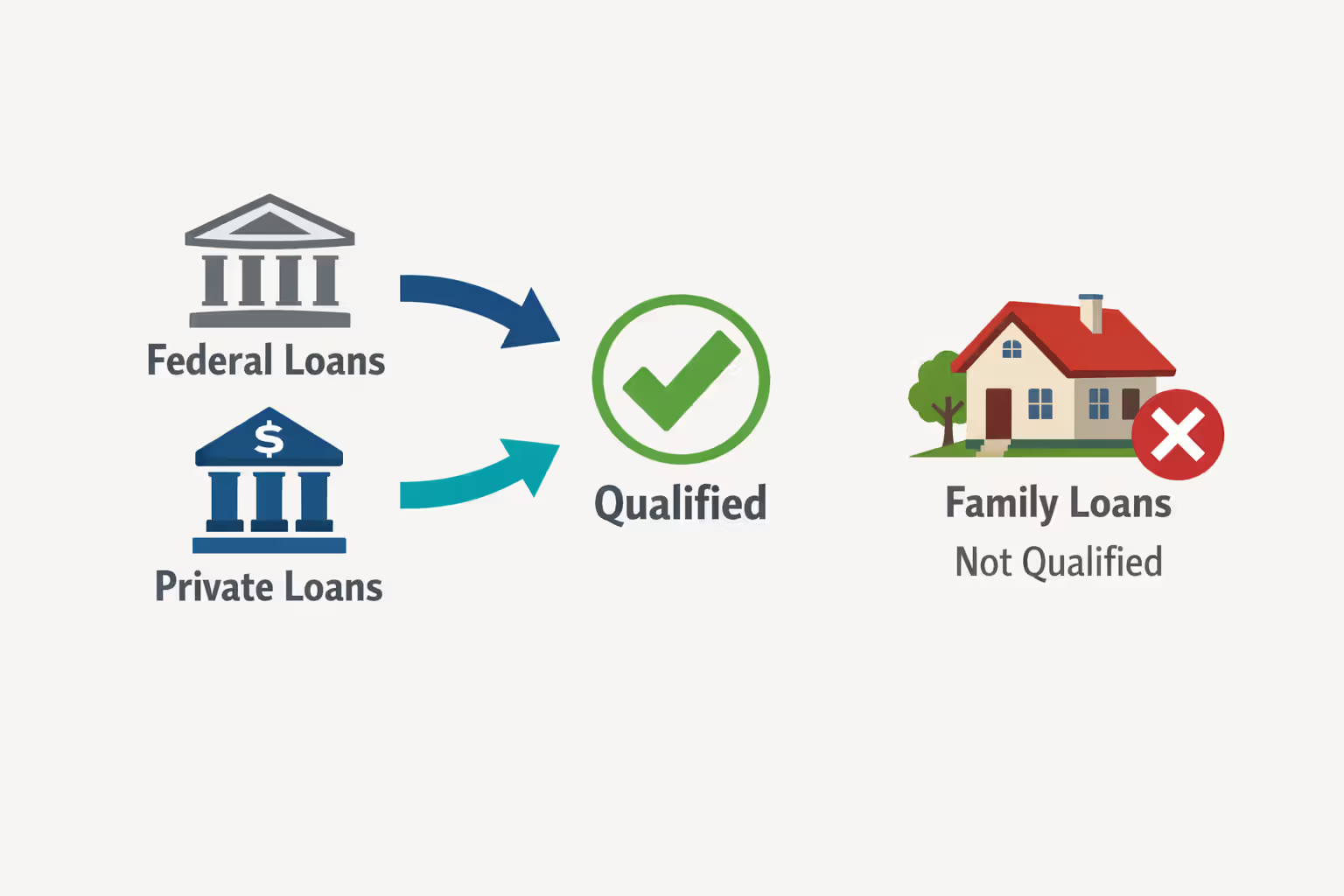
Federal and private education loans both qualify, provided they meet the definition of approved education debt. Borrowing must originate from qualified lenders—encompassing most banks, credit unions, schools, and the federal government—while excluding loans from relatives or employer retirement plans.
Federal education loans—Direct Subsidized, Direct Unsubsidized, Direct PLUS (both parent and graduate versions), and legacy FFEL and Perkins programs—all meet standards. Private education loans from banks and commercial lenders qualify when proceeds funded education costs exclusively.
Author: Danielle Pierce;
Source: sonicmusic.net
Parent PLUS loans generate a unique scenario. Parents borrowing PLUS loans for dependent children's education can claim deductions (assuming they satisfy other conditions) because parents carry legal repayment obligations. Students cannot claim these deductions since they're not contractually obligated. Once the student loses dependent status, this doesn't change—parents remain the borrowers.
Refinanced education debt generally maintains eligibility provided the new loan paid off approved education loans without exceeding original amounts. Refinancing $40,000 in education debt but borrowing $50,000 while using the extra $10,000 for a vehicle means interest attributable to that $10,000 fails qualification. Lenders won't itemize this on Form 1098-E, requiring personal calculation of non-qualified portions.
Only interest qualifies—not principal, origination charges, late penalties, or other fees. Most loan payments combine principal and interest; servicer statements separate each payment's components. Form 1098-E reports exclusively the interest portion.
Capitalized interest—unpaid interest added to principal balances—becomes deductible when you actually remit payment, not when capitalization occurs. If $2,000 in interest capitalized during enrollment and later payments include interest on that capitalized amount, those payments count toward deductibility.
Voluntary interest payments during deferment or continued enrollment qualify. Some borrowers pay interest while attending to prevent capitalization. These payments count toward the deduction in the payment year, assuming eligibility requirements are satisfied.
Consolidation doesn't eliminate eligibility. Consolidating multiple federal loans into a Direct Consolidation Loan maintains qualified status. Private consolidation loans paying off approved education debt work identically.
Common Mistakes That Disqualify Your Deduction
Several recurring errors eliminate this tax benefit entirely, with IRS automated systems and audits detecting these violations.
Dependent status represents the most frequent disqualifier among recent graduates. Even when you personally paid interest and received Form 1098-E in your name, claimability as someone else's dependent eliminates your deduction. Parents sometimes fail to recognize that claiming their 22-year-old graduate costs that child this tax benefit. Compare options: does the parent's dependent claim deliver more tax value than the child's education loan deduction?
Married filing separately status creates automatic disqualification for both spouses, regardless of whose name appears on loans or who made payments. Some couples select separate filing to access income-driven repayment programs with reduced payments. This approach might make financial sense overall, but recognize you're forfeiting this tax deduction.

Author: Danielle Pierce;
Source: sonicmusic.net
Relative-sourced loans don't qualify. If parents lent you money for college through formal promissory notes, interest paid to them isn't deductible. Employer qualified retirement plan loans carry the same restriction—interest on 401(k) loans funding education costs doesn't qualify.
Non-qualified expense usage disqualifies interest attributable to those costs. Approved education expenses encompass tuition, mandatory fees, housing and meals (within institutional cost-of-attendance limits), textbooks, supplies, required equipment, and necessary costs like transportation. They exclude entertainment, education-unrelated travel, or sports, games, and hobbies unless your degree program requires them.
Borrowing $30,000 but applying only $25,000 toward qualified expenses means only 83.3% of your interest qualifies. Lenders don't track fund usage, making this your calculation and record-keeping responsibility.
Income limit violations eliminate deductions for high earners. MAGI reaching upper thresholds ($95,000 for individuals, $195,000 for joint filers in 2026) produces zero deduction regardless of interest paid. The phaseout doesn't gradually taper—exceeding the upper limit by $1 eliminates the entire benefit.
Forgetting actual payment costs some borrowers their deduction. Loans in deferment with accruing but unpaid interest cannot be deducted. You must actually remit payment during the tax year to claim that year's deduction.
FAQ
This education loan tax benefit delivers substantial relief for borrowers managing education debt repayment. Reducing taxable income up to $2,500 annually without itemization requirements keeps this above-the-line adjustment accessible to most borrowers satisfying eligibility standards.
Successful claiming requires attention to multiple factors: maintaining qualifying filing status, ensuring you're not claimable as a dependent, monitoring your MAGI to remain within income boundaries, and maintaining accurate interest payment records. The phaseout structure means borrowers approaching income thresholds should calculate expected deductions before year-end to evaluate whether income-timing strategies might preserve eligibility.
Form 1098-E streamlines claiming for most borrowers, but those paying under $600 in interest shouldn't dismiss this benefit—you can still claim it with appropriate documentation. Whether managing federal loans, private debt, or refinanced obligations, understanding qualification versus disqualification factors prevents expensive tax-time errors.
As your circumstances change—through marriage, career progression, or debt payoff—reassess eligibility annually. Tax code interaction with education debt creates planning possibilities, but only when you understand the regulations and correctly apply them to your specific situation.
Related Stories

Read more

Read more




The content on this website is provided for general informational and educational purposes only. It is intended to offer guidance on student loan topics, including federal and private student loans, interest rates, repayment plans, loan forgiveness programs, deferment, forbearance, consolidation, and related financial matters. The information presented should not be considered legal, financial, tax, or professional lending advice.
All information, articles, explanations, and program discussions published on this website are provided for general informational purposes. Student loan programs, repayment options, forgiveness eligibility, and financial assistance policies may change over time and may vary depending on government regulations, loan servicers, lenders, borrower eligibility, income level, school status, and individual loan terms. Details such as interest rates, repayment schedules, eligibility for forgiveness programs, and application requirements may differ between federal and private lenders and may change without notice.
While we strive to keep the information accurate and up to date, this website makes no guarantees regarding the completeness, reliability, or accuracy of the content. The website and its authors are not responsible for any errors, omissions, or actions taken based on the information provided here.
Use of this website does not create a financial advisor–client, legal, or professional relationship. Visitors are encouraged to review the official documentation provided by the U.S. Department of Education, student loan servicers, and private lenders, and to consult with a qualified financial advisor, loan specialist, or legal professional before making decisions regarding student loans, repayment strategies, or financial obligations.