
Student reviewing college loan documents and financial aid papers at a desk
Undergraduate Student Loans Guide

Most students can't write a check for $100,000+ to cover four years of college. That's reality. You'll probably need to borrow money, and the loan decisions you're making right now—today, while filling out forms and clicking "accept" on financial aid packages—these choices will follow you long after you've tossed your graduation cap.
Here's what makes this tricky: you're trying to decode terms like "aggregate limits," figure out why some loans don't charge interest while you're in school, and understand whether your parents' income affects how much you can borrow. It's a lot.
This guide breaks down everything you need to know. We'll cover what these loans actually are, how federal options stack up against private bank loans, exactly how much you can borrow each year, the step-by-step application process, ways to handle repayment, and the mistakes that trap too many borrowers.
What Are Undergraduate Student Loans?
Think of these as borrowed money specifically designed to pay for your associate or bachelor's degree. Unlike scholarships that you never repay or grants that function as gifts, every borrowed dollar comes back to haunt you—plus interest that compounds over time. You'll use these funds for tuition bills, dorm fees, meal plans, required books, and related education expenses when your savings and free financial aid don't stretch far enough.
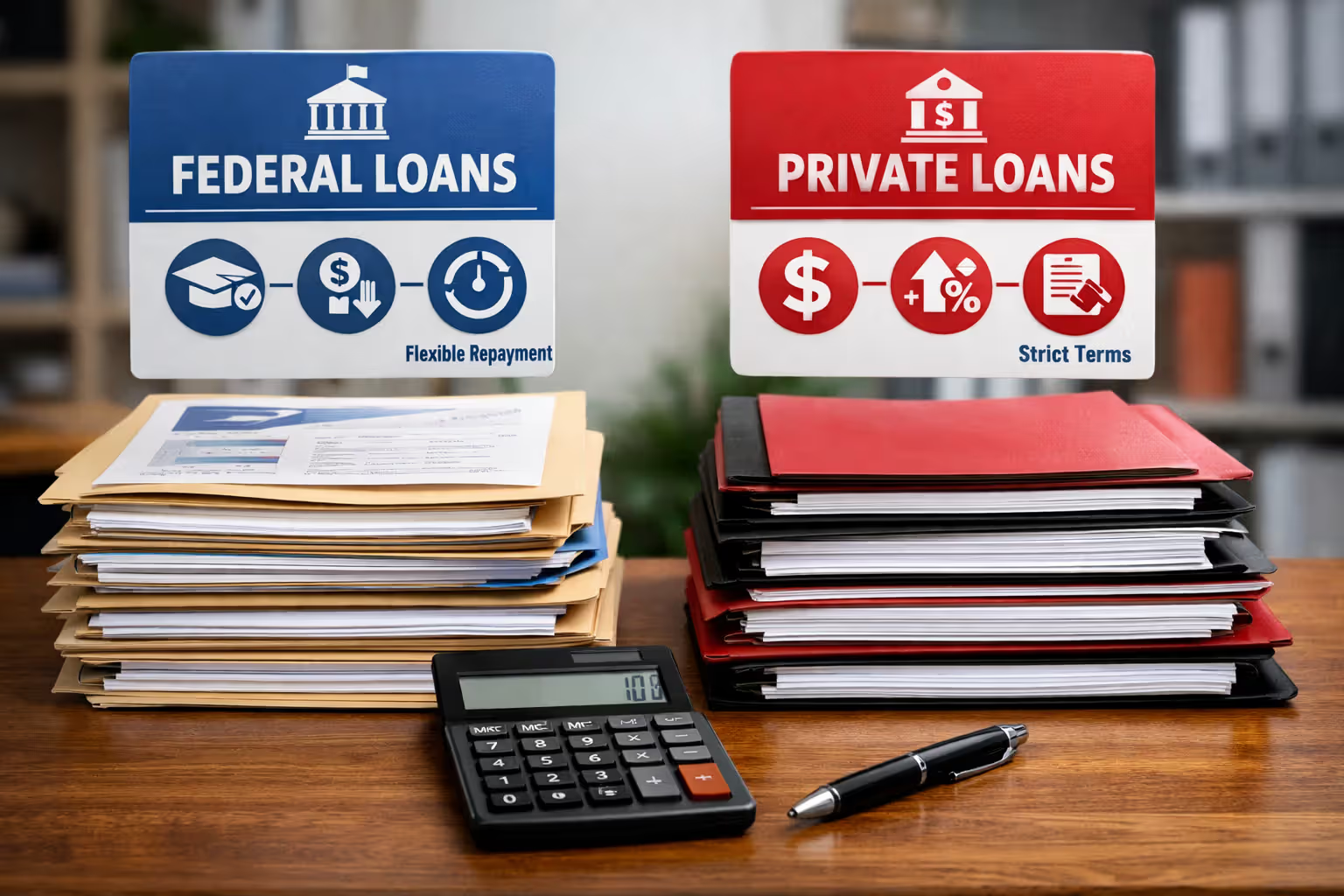
Two categories dominate this space: federal and private. Federal options come directly from the U.S. Department of Education. Congress sets the interest rates each spring. You'll get access to payment plans that adjust based on your actual income, options to temporarily pause payments during hardships, and potential eligibility for loan forgiveness programs if you work in certain fields. Private options? Those come from banks, credit unions, and online lending companies. They'll check your credit score (or require someone to co-sign), set their own interest rates based on market conditions, and almost never offer the flexible repayment terms you'll find with government programs.
Financial aid advisors repeat the same advice constantly: drain your federal borrowing options completely before you even think about approaching a private lender. Why? Government loans build in stronger protections. Even better, one specific federal program—subsidized loans—won't charge you any interest while you're enrolled at least half-time in classes.
Author: Evan Thornton;
Source: sonicmusic.net
Types of Federal Undergraduate Student Loans
The Department of Education runs three separate programs for undergrads. Each comes with different rules about who qualifies and what advantages you'll receive.
Direct Subsidized Loans
You can't access these unless you're working toward an undergraduate degree AND your FAFSA results prove you have financial need. The big advantage? The government pays your interest charges during three specific windows: while you're taking classes at least half-time, throughout the six-month grace period after you leave school, and during any approved deferment periods.
This interest subsidy saves you serious money. Picture this: you borrow $3,500 your first year at a 5.5% rate and stay enrolled for four years. When your first bill arrives, you'll owe exactly $3,500—not a penny more. Now imagine you borrowed that same $3,500 through an unsubsidized loan instead. You'd owe roughly $4,270 because interest was piling up behind the scenes. That's an extra $770.
Not everyone gets these. Your family's income matters. Students from wealthier households typically don't demonstrate enough financial need to qualify. There are also caps on how much you can borrow each year and across your entire college career, which we'll examine in detail shortly.
Direct Unsubsidized Loans
These are available to any undergraduate student—no proof of financial hardship required. Your parents could earn $300,000 annually and you'd still qualify. The catch? Interest starts accumulating the day your school receives the money. You can make interest-only payments while you're still in school if you want. Or you can ignore it and let those charges capitalize—which means they get added to your original loan balance—when you enter repayment.
Letting interest capitalize costs you. Borrow $5,500 as a freshman and ignore the interest for four years at 5.5%. Roughly $1,210 in interest will fold into your principal balance, pushing your total debt to $6,710 before you've made a single payment toward the actual loan.
Here's the rule: if you qualify for both subsidized and unsubsidized loans, always max out the subsidized option first. You'll pay less overall.
Direct PLUS Loans for Parents
Parent PLUS loans let your mom or dad borrow enough to cover your entire cost of attendance minus whatever other aid you've received. There's a credit check involved—parents with recent bankruptcies, defaults, or other serious credit problems might get denied unless they find someone to endorse the loan or can document why those credit issues happened.
The rates are steeper than what students pay on Direct Subsidized or Unsubsidized Loans. For 2026, Parent PLUS charges 8.05% compared to the 5.50% undergraduates face. Repayment starts immediately after the loan is fully disbursed, though parents can request a deferment while you're still enrolled.
One critical detail: these loans belong entirely to your parent, not you. They're legally responsible for every payment. The debt doesn't magically transfer to you after graduation.
Students who sign loan documents without understanding the terms often face unpleasant surprises when bills arrive. Spending 30 minutes learning about your loan obligations before accepting funds can prevent decades of financial regret
— Jennifer Martinez
Undergraduate Student Loan Limits and Borrowing Caps
Federal rules cap your borrowing each academic year and across your entire undergraduate education. The limits vary depending on whether financial aid formulas classify you as dependent on your parents or independent, plus which year of college you've reached.
| Academic Year | Dependent Student (Annual Max) | Independent Student (Annual Max) | Subsidized Portion Cap |
| Freshman | $5,500 | $9,500 | $3,500 |
| Sophomore | $6,500 | $10,500 | $4,500 |
| Junior and Senior | $7,500 | $12,500 | $5,500 |
| Lifetime Maximum | $31,000 | $57,500 | $23,000 |
Dependent students hit a wall at $31,000 total borrowing; independent students can borrow up to $57,500. The subsidized portion maxes out at $23,000 for everyone, which means anything beyond that must come through unsubsidized loans.
Let's walk through an example. You're classified as dependent and borrow the maximum each year across four years. Freshman year: $5,500. Sophomore year: $6,500. Junior and senior years: $7,500 each. Total borrowed: $27,000, which stays under the $31,000 lifetime cap. If you needed a fifth year to graduate, you could borrow another $4,000 before hitting your ceiling.
Independent students get higher limits because the government assumes they don't have parents chipping in financially. To qualify as independent, you typically need to be married, have your own dependents, have served in the military, or meet other specific federal criteria. A junior-year independent student can borrow $12,500 annually—$5,500 subsidized and $7,000 unsubsidized.
These restrictions only apply to federal Direct Loans. Parent PLUS programs operate under completely different rules, and private lenders set their own borrowing limits based on credit and income.
Author: Evan Thornton;
Source: sonicmusic.net
How to Apply for Undergraduate Student Loans
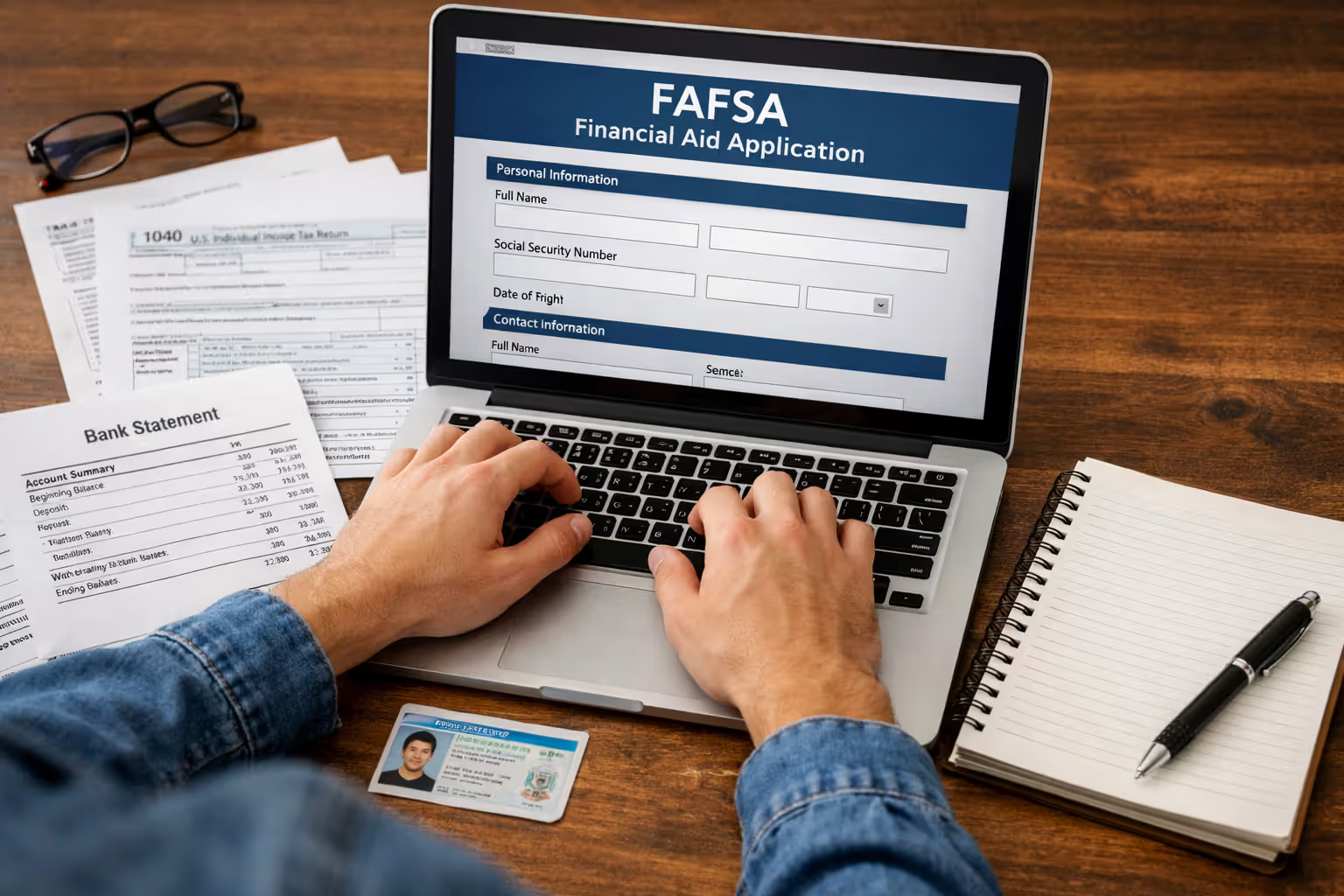
Everything starts with the FAFSA, which opens every October 1 for the upcoming academic year. You'll need several documents handy: Social Security number, driver's license, tax returns (preferably pulled directly from the IRS), W-2 forms from any jobs, bank statements showing your account balances, and records of any untaxed income like child support.
The FAFSA crunches these numbers and spits out your Expected Family Contribution—recently rebranded as the Student Aid Index. Colleges use this figure to calculate your financial need. A few weeks later, schools send financial aid award letters showing what grants you've earned, whether you qualify for work-study, and how much you're eligible to borrow.
Read that award letter carefully. Just because a school offers you $6,500 in loans doesn't mean you must accept the full amount. If you only need $4,000 to cover your actual gap, accept $4,000. Borrowing less means paying less interest down the road.
After you've accepted a loan offer, first-time borrowers must complete entrance counseling and sign a Master Promissory Note. The counseling takes about 30 minutes online and covers your rights, responsibilities, and what happens if you don't repay. The MPN is your legal contract promising to repay everything you borrow.
Your school's financial aid office receives the funds directly and applies them to your student account, usually in two disbursements per academic year. If money remains after covering tuition and fees, the school refunds the excess to you for rent, books, and other expenses.
Timing matters more than most students realize. Some state grants and institutional aid operate on a first-come, first-served basis. Submitting your FAFSA in October or November—rather than waiting until March or April—can mean the difference between receiving aid or missing out because funds ran dry.

Author: Evan Thornton;
Source: sonicmusic.net
Private Student Loans for Undergraduates
Sometimes federal loans, grants, scholarships, and family contributions still leave a funding gap. That's when private lenders enter the picture. Banks, credit unions, and online lending platforms offer these products, but they work very differently than federal loans.
Private lenders approve applications and determine rates by evaluating creditworthiness. Since most undergraduates haven't built substantial credit histories yet, lenders usually demand a cosigner—typically a parent or another relative with solid credit and stable income. Cosigners aren't just formalities; they accept equal legal responsibility for the debt. Miss payments and the lender can sue your cosigner just as easily as they can sue you.
Interest rates on private loans range dramatically, anywhere from roughly 4% to 14% or higher depending on credit scores and current market conditions. Federal loans charge fixed rates set by Congress each May. Private loans? Many feature variable rates tied to market indexes like SOFR or prime. A variable rate starting at 5% might climb to 8% or higher across a decade-long repayment period.
You lose the federal safety net with private borrowing. Income-driven repayment plans don't exist. Public Service Loan Forgiveness isn't available. Automatic payment postponements during financial hardships? Not standard. Some lenders offer forbearance programs or cosigner release after 24+ consecutive on-time payments, but policies vary wildly between companies.
When does private borrowing make sense? Only after you've maxed out federal Direct Loan limits and hunted down every scholarship opportunity. Request rate quotes from multiple lenders and compare interest rates, origination fees, repayment term options, and cosigner release policies. A loan charging 6% interest with zero fees beats one at 5.5% interest that tacks on a 4% upfront origination fee.
Repayment Options and Managing Undergraduate Loan Debt
Your federal loans enter repayment six months after you graduate, drop below half-time enrollment, or withdraw from classes. This grace period gives you time to land a job and figure out your budget.
Standard repayment spreads payments across 120 months (10 years) using fixed monthly amounts. Borrow $30,000 at 5.5% interest and you'll pay approximately $326 monthly while racking up $9,120 in total interest charges.
Can't afford standard payments? Income-driven repayment plans cap your monthly bill at 10% to 20% of discretionary income. Four plans are available: Income-Based Repayment, Pay As You Earn, Revised Pay As You Earn, and Income-Contingent Repayment. Make qualifying payments for 20 or 25 years (depending on the plan) and any remaining balance gets forgiven—though you might owe taxes on the forgiven amount.
Deferment and forbearance temporarily pause payments during unemployment, economic hardship, or if you return to school. With subsidized loans in deferment, interest stops accruing. With unsubsidized loans—or any loans in forbearance—interest keeps piling up even while payments are paused.
Public Service Loan Forgiveness wipes out your remaining balance after 120 qualifying payments (10 years) while working full-time for government agencies or 501(c)(3) nonprofits. You must enroll in an income-driven plan and submit annual employment verification forms to stay on track.
Want to minimize your total debt? Borrow only what you absolutely need. Pay interest during school if you can swing it financially. Consider graduating a semester early or knocking out general education requirements at a community college first. Every $1,000 you avoid borrowing saves roughly $300 in interest over a standard 10-year repayment.

Author: Evan Thornton;
Source: sonicmusic.net
Common Mistakes When Borrowing Undergraduate Student Loans
Too many students borrow more than they need and treat refund checks like free money. That $2,000 refund you spent on spring break will actually cost you around $2,600 to repay over 10 years. Stick to education-related necessities only.
Another trap: accepting unsubsidized loans before maximizing subsidized eligibility. Some students don't realize their award package contains both types and accept everything without distinguishing between them. Always grab the subsidized money first.
Ignoring interest accumulation creates nasty surprises later. Students who skip interest payments on unsubsidized loans during school often enter repayment owing 20% to 30% more than they originally borrowed. Making small $50 or $100 monthly interest payments while enrolled keeps balances under control.
Rushing through entrance and exit counseling—clicking through screens without actually reading—means missing crucial information about repayment obligations, deferment options, and default consequences. Default happens after 270 days without payment and triggers wage garnishment, tax refund seizure, and devastating credit score damage.
Forgetting to update your contact information with your loan servicer after graduation causes you to miss payment notices and accidentally fall into delinquency. Set up automatic payments to avoid late fees and qualify for a 0.25% interest rate reduction.
Finally, some students waste their grace period assuming they have forever before payments start. Use those six months to build a realistic budget, research repayment plan options, and contact your servicer with questions.
Frequently Asked Questions About Undergraduate Student Loans
Student loans make college accessible for millions who couldn't otherwise afford degree programs. Federal programs offer the best terms—especially Direct Subsidized Loans that don't charge interest during enrollment. Understanding borrowing limits, FAFSA deadlines, and differences between loan types helps you make informed choices that minimize long-term debt.
Only borrow what you genuinely need. Prioritize subsidized over unsubsidized options. Hunt down every available grant and scholarship before accepting loans. Watch how interest accumulates. Complete required counseling sessions. Keep your contact information current with your servicer after leaving school.
The choices you're making now—whether to borrow $20,000 or $50,000, whether to understand repayment options or stumble into default—will shape your financial reality for decades. Treat borrowing as a serious financial obligation, not just paperwork to rush through, and you'll build a foundation for manageable repayment after graduation.
Related Stories

Read more

Read more




The content on this website is provided for general informational and educational purposes only. It is intended to offer guidance on student loan topics, including federal and private student loans, interest rates, repayment plans, loan forgiveness programs, deferment, forbearance, consolidation, and related financial matters. The information presented should not be considered legal, financial, tax, or professional lending advice.
All information, articles, explanations, and program discussions published on this website are provided for general informational purposes. Student loan programs, repayment options, forgiveness eligibility, and financial assistance policies may change over time and may vary depending on government regulations, loan servicers, lenders, borrower eligibility, income level, school status, and individual loan terms. Details such as interest rates, repayment schedules, eligibility for forgiveness programs, and application requirements may differ between federal and private lenders and may change without notice.
While we strive to keep the information accurate and up to date, this website makes no guarantees regarding the completeness, reliability, or accuracy of the content. The website and its authors are not responsible for any errors, omissions, or actions taken based on the information provided here.
Use of this website does not create a financial advisor–client, legal, or professional relationship. Visitors are encouraged to review the official documentation provided by the U.S. Department of Education, student loan servicers, and private lenders, and to consult with a qualified financial advisor, loan specialist, or legal professional before making decisions regarding student loans, repayment strategies, or financial obligations.